Anthony Firulli: "My goal is to spend as many days as possible with a smile on my face"


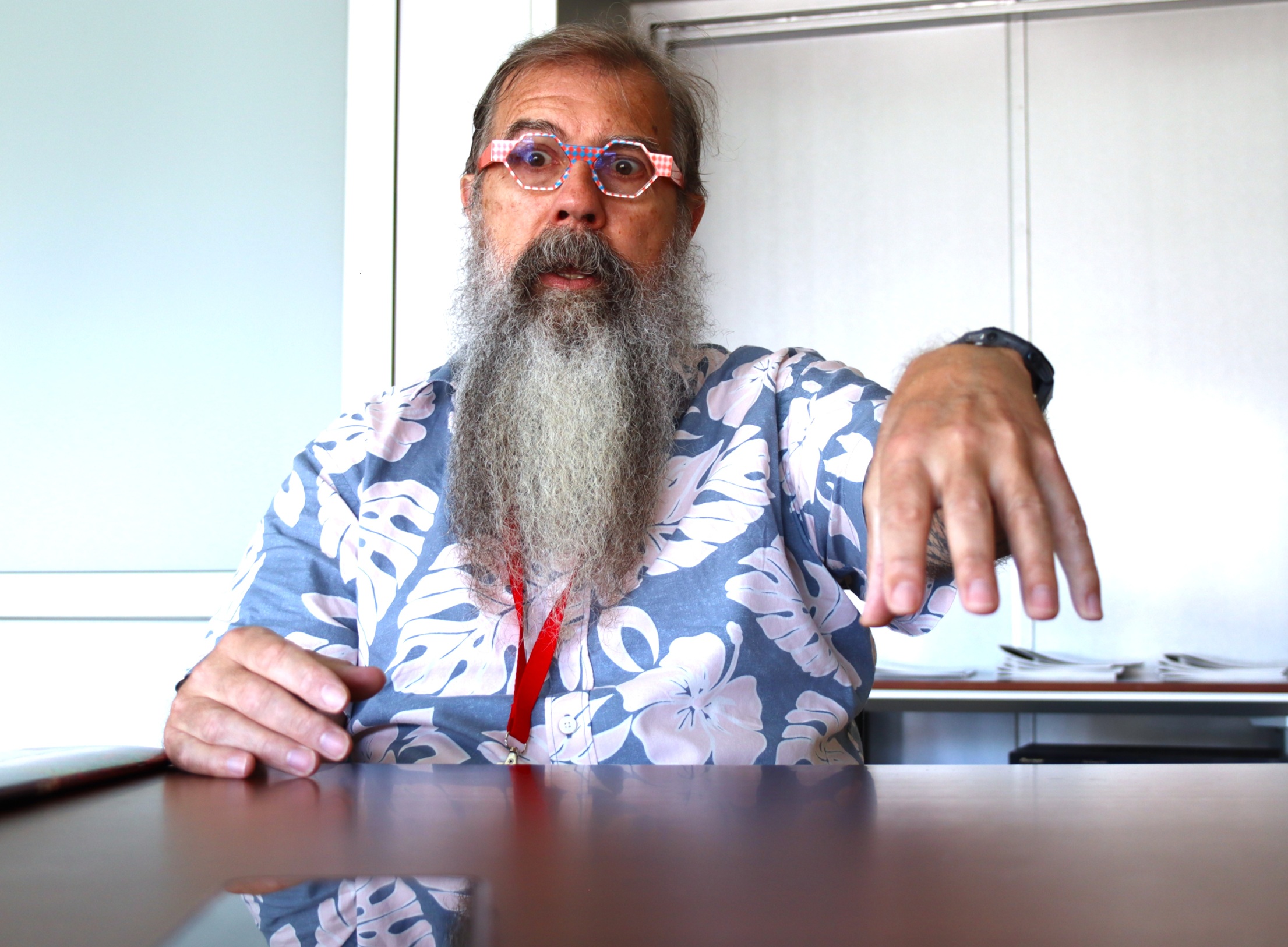
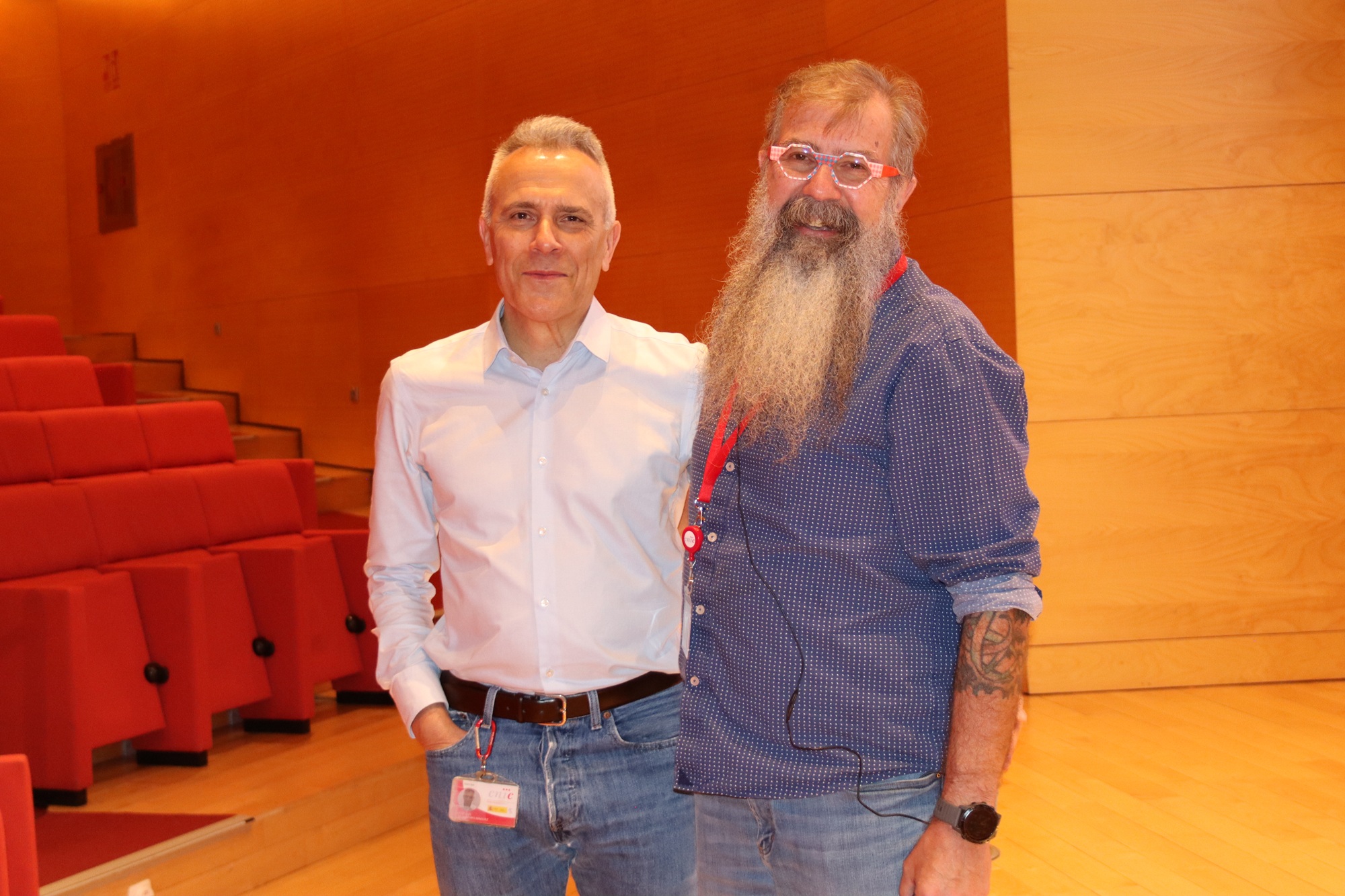
Anthony Firulli is a senior biomedical researcher with more than 25 years of experience leading a laboratory in the Indiana University School of Medicine, where his work focuses on gene regulation, developmental biology, and disease mechanisms. He recently took part in the Visiting Researchers Programme at the Fundación Occident at CNIC, collaborating with international teams and exploring the use of artificial intelligence in biological data analysis.
Born in the United States to a family of mixed heritage—Italian, Irish, and Swedish—Firulli reflects the multicultural background that has shaped much of American scientific life. Outside the lab, he leads an active and grounded personal life: he owns five dogs and keeps chickens at his home, interests that reflect his enjoyment of everyday routines beyond science. His career has been driven by both curiosity and persistence, combining rigorous research with a strong belief in collaboration, mentorship, and the social value of science.
- You have just finished your residency as a researcher in the Visiting Researchers Programme run by the Occident Foundation. What is your opinion about this program?
I’ll start by saying that in the 25 years or so that I’ve been running a lab, this has been the most morale-invigorating and exciting experience I think I’ve ever had. It’s been such a privilege to interact with the people here and to be exposed to a scientific culture I wasn’t familiar with.
- What exactly did you do at CNIC?
What I’ve been doing here is working closely with José Luis de la Pompa’s team. They’ve shared manuscripts they are preparing for submission, and I’ve been able to read them and provide feedback, which they’ve incorporated.
I’ve also had the chance to sit down without many distractions and write about two-thirds of a major grant. In addition, I’ve been using artificial intelligence to analyze datasets and identify new relationships.
For example, you can ask it to identify genes that are consistently upregulated or downregulated across models, or genes with transcription factor binding peaks, and organize everything into tables. From there, you can start to interpret the biology—if a gene is up in all these mutants and we know a factor is binding, you can then look at regulatory elements and define the next step.
Doing this manually would require enormous effort—highlighting, printing, organizing everything physically—whereas AI is incredibly powerful for pattern recognition. It’s absolutely astounding in that regard. It’s less effective for thinking, but if you guide it properly—set the right constraints and only use validated data—it becomes a very powerful tool.
It has also given me time to reflect on where I am in my career and where I want to go. I’ve had the opportunity to learn about the excellent science being done in José’s lab and to interact with students.
- Maybe some of these students could go to your lab in the US?
That would be wonderful. My experience here has been more than just scientific; it’s been a full immersion that has elevated my enthusiasm, my energy, and my science.
I feel like I’ve built a whole new network of colleagues.
I initially thought seven weeks would feel long, but it feels incredibly short. This program is a fantastic opportunity, and I’m sure other visiting scientists would say the same.
Ultimately, the only way we truly learn from each other is through direct interaction. This experience has given me a much better understanding of how science works in Europe.
- You mentioned your family comes from Italy?
Yes, My ancestors came from Sicily and emigrated in the early 20th century. My mother isn’t Italian—she’s Irish and Swedish.
- You are an example of what the United States is—a mixture of people from everywhere.
I suppose that’s true. It’s interesting because what you’re told growing up is what you believe. My sister did genetic testing and discovered unexpected ancestry, like Scottish heritage, and the proportions weren’t exactly what we thought.
It shows that when you question what you assume to be true, you often find surprises. That’s exactly why science is so powerful—it allows you to re-examine accepted truths and discover new dimensions of understanding.
- Does that also happen in your scientific career?
Absolutely. Two sayings have shaped how I approach science. When I was a graduate student, a postdoc used to say, “It’s better to be lucky than good.” Later, as a postdoc, I heard the opposite: “The harder you work, the luckier you get.”
Both are true. There is always some element of luck in discovery, but hard work is essential.
Many years ago, using a yeast two-hybrid screen, we identified a PP2A phosphatase subunit (delta B56) that regulates HAND1 through phosphorylation. We discovered that specific sites in HAND1 are phosphorylated by PKA and PKC and dephosphorylated by PP2A, revealing a conserved regulatory mechanism shared across the Twist protein family.
We then linked this mechanism to human disease: mutations in TWIST1 that cause Saethre-Chotzen syndrome disrupt this phosphoregulation.
Mouse studies further showed that Twist and Hand2 act as opposing signals in limb development, with their balance controlling digit formation.
Overall, a basic protein interaction study led to identifying a molecular mechanism underlying a human genetic disorder and suggested that switching dimer partners among bHLH proteins regulates developmental programs..
That then became an entire decade of work—trying to understand what this switching of dimer partners actually does in biology.
So yes, that discovery involved a lot of luck—but also a great deal of hard work. It goes back to those two sayings: it’s better to be lucky than good, but the harder you work, the luckier you get.
And if you examine your data carefully enough, it’s like the genealogy example: you start seeing things you didn’t expect, and suddenly a whole new world opens up.
That’s what I’ve always loved about science. First of all, it’s a privilege to do it. Science depends on society investing in discovery. The building I work in back in the United States exists because people collectively believe in the value of finding things out and support people who are dedicated, motivated, and enthusiastic about doing that work.
It’s also wonderful to come into José Luis’s lab and see these young students who are just starting out, so excited and eager to discover something. They show me their data, and you immediately realize: they are the future.
That is probably the most amazing thing I can say. No matter how old you get, no matter how tired you become of bureaucracy and all the frustrations of academic life, when you see that kind of enthusiasm, it takes you back to when you were a graduate student yourself.
- Don’t you think that people are increasingly losing trust in science because of fake news, conspiracy theories, and everything that became so visible during the COVID pandemic?
It is a huge problem, and I honestly don’t know whether it is fully solvable.
If you go back and look at US newspapers from the 1950s, you will already find opinion pieces attacking the polio vaccine and warning against it, even at a time when children were still ending up in iron lungs. So this tendency to distrust science, whether based on facts or not, has always existed.
What is new is that social media has given everyone a voice. Anyone can become an influencer. Anyone can tell a story, whether it is based on evidence, emotion, or ideology. And when people don’t consider the source carefully, they may assume that if something is written down or shown with an image, it must be true.
We need to find ways to distinguish between vetted, reliable information and opinion masquerading as fact. A ridiculous example is flat-earth belief. We’ve been to space, there are footprints on the Moon, and yet there are still people who refuse to accept that the Earth is round, even though they could look at Jupiter through a telescope and see for themselves that it is spherical.
- I read about Artemis II, and there are already people saying that it is fake. Is everything fake now?
Not to play devil’s advocate, but I can understand how some people end up thinking that way. When I was a kid, I loved Star Trek, and then Star Wars came out. I remember seeing the first movie in theaters. You see planets, spacecraft, the Death Star—all of these visual worlds that are clearly fictional.
So if someone is already inclined not to accept reality, I can see how they might tell themselves that space missions are fake too.
But what really interests me is the deeper question: why do some people not want to accept something new?
- I believe that is inherent to human nature.
Exactly. And that is where the challenge becomes social and political, not just scientific. If you live in a democracy where everyone has freedom of speech and every voice can be expressed, how do you deal with speech that is harmful to the common good?
That is not really the scientist’s job. It has more to do with how laws and institutions are structured. In the United States, freedom of speech does not protect you if you shout “fire” in a crowded movie theater. So there are already limits.
In the same way, I think that if you call yourself a news source, there should be some obligation not to accuse someone of being a murderer, for example, unless you have source material and evidence. Otherwise, you are spreading lies.
But podcasts, social media, and internet content have dissolved many of those boundaries. Traditional news organizations are competing for attention, and because there is now a 24-hour news cycle, they are under constant pressure to make everything more dramatic and more interesting.
Some days there is simply not much happening. No volcano, no election, no crisis. But those platforms still have to fill airtime. So they bring on charismatic people who stir conflict, and little by little, audiences form bubbles around voices that “sound like them” and reinforce what they already believe.
After twenty-five years of that, you end up with communities of people who only trust a very narrow set of sources—and those sources are often not vetted at all. It’s terrible.
- But that also happens in real life, not only on social media. People prefer talking to those who think like them.
Yes, that is true. And it’s interesting because even in ordinary life, we naturally form communities around what interests us. I like talking about science, bicycles, dogs, chickens, and food. But if I go to my scientific colleagues and start talking about chickens or bicycles, many of them won’t care at all.
So we do create our own circles around shared interests.
One of my favorite sayings is that data never lies. You do an experiment, and the results exist. The problem is not the data itself—it is how we interpret it. My interpretation may fit the results perfectly and still be completely wrong.
That is what scientific debate is often about: interpretation. One person says the data mean this; another person says they mean something else. The only real way forward is to do more experiments that help rule possibilities in or out.
That is the essence of science. I have papers of my own where the conclusions I drew turned out to be wrong. But the data in those papers were still valid. The issue was that we were missing another factor, and at the time our interpretation seemed logical.
Think about older ideas in natural philosophy. People once believed fire was an element—phlogiston, as it was called—because it seemed to fit the observable world. Water is there, you can touch it; fire is there, you can touch it too, although you get burned. So it made sense to classify it as another element.
Fire was real. The interpretation was not. As our understanding became more refined, we learned that fire is a process, a chemical reaction, not an element.
The same thing happens throughout science. In the early twentieth century, even brilliant figures like Einstein and Niels Bohr worked with models of electrons, neutrons, and protons that we now know are incomplete. Today we understand that protons are made of quarks, and even that picture continues to evolve.
When I studied chemistry, we learned about electron orbitals as if they were structured shapes. Quantum mechanics later taught us that electrons are better understood as probability clouds. Once you measure them, you know where they are—but before that, the reality is more complicated.
So even things we have “known” for a century continue to surprise us. Take cosmology. The universe is expanding, and it is expanding faster all the time. Why? What is driving that acceleration? Is it dark energy? Is it something else? Did the Big Bang happen exactly the way we think it did?
These are the kinds of questions scientists ask, whether they are physicists or biologists.
And every time someone invents a clever technology or proposes an idea that sounds crazy, but then demonstrates experimentally that something real is there, our understanding expands again.
When I started graduate school, you could write an entire PhD thesis around cloning and sequencing one new cDNA—a new gene product.
Today, you could do that in an afternoon. It would just be one step in a much larger experiment.
Back then, the Human Genome Project had only just begun, using technology that would now look painfully slow and inefficient. My wife worked in a sequencing center in Houston, dealing with yeast artificial chromosomes—YACs—used to map different human chromosomes.
The goal was to walk across those chromosomes and sequence them using methods that now seem almost primitive.
Today, with next-generation sequencing, you can sequence an entire human genome in a matter of hours. We now have complete genomes for mice, rats, possums, and many other species, and we can manipulate those genomes much more easily.
When I was a postdoc, homologous recombination was the cutting-edge method for doing loss-of-function studies in mice. Now CRISPR lets you do that with astonishing speed and precision.
That is the steady progression of science: new methods make older things faster and more efficient, which means you can generate more data, think of bolder questions, and move into new areas.
I always tell people that CRISPR comes from the immune system of bacteria. Scientists studying CRISPR-Cas9, CRISPR-Cas12, and related enzymes revolutionized biomedical science by studying something completely different.
That, to me, is also part of creativity: sometimes one brilliant idea changes everything.
- When you were a child, did you always want to be a scientist?
I think so. I had a chemistry set when I was seven years old. It came in a box with test tubes, and I loved using it—lighting the little alcohol lamp and just experimenting.
I’ve always been fascinated by discovery. I used to watch wildlife programs, and at first I wanted to become a marine biologist because Jacques Cousteau completely captivated me. I imagined myself living in a wetsuit on a boat, discovering huge things under the sea.
As I progressed through college, I became interested in other forms of biology too, and eventually I made a pragmatic choice. Marine biologists were among the lowest-paid biologists, so I switched to general biology to keep more options open. I also added a chemistry degree as a hedge.
By senior year I was anxious about graduating and finding a job, and a friend asked me why I didn’t go to graduate school. I had no idea what graduate school even was. My college was small and had no graduate program.
He showed me a bulletin board full of applications, and I started applying. I ended up at Roswell Park Cancer Institute in Buffalo, in a cancer biology lab, where I did my thesis on alternative DNA structure.
That is also where I met my wife. She was from Texas, and when I was giving my first poster in Houston, she suggested I look for a postdoc there so we could be closer to her family.
So I did. And that is how I ended up approaching Eric N. Olson after a talk. I basically said, “I hear you’re looking for postdocs, and I’m looking for one.” He took me to his lab right then and there and hired me on the spot.
Eric Olson is one of the most influential developmental and muscle biologists of the last thirty years, so suddenly I found myself in this extraordinary scientific environment.
And then I just kept learning and doing. Thirty years later, here I am. Looking back, I can see that chance encounters with the right people acted like signposts that guided my whole career.
- During the Fundación Occident Visiting Researchers Programme meeting, you had a very interesting conversation with Dr. Fuster about artificial intelligence.
And he deeply impressed me. At his age, he still has extraordinary sharpness. He understood both the clinical and the basic research dimensions in remarkable depth, and he asked very challenging questions.
What was especially interesting is that both of us were using AI, but for very different purposes. That led naturally into a broader philosophical discussion.
The upside of AI is obvious: it can be incredibly productive.
The downside is that, if it is not used intelligently, it may make people mentally lazy. It’s like exercising a muscle—if you stop using it, it weakens. The brain is no different.
If people get used to typing a few prompts and having letters, recommendations, or summaries written for them all the time, they may gradually lose the habit of organizing their own thoughts clearly.
That would be a real detriment.
I hope that does not happen.
- I hope so too.
But being afraid of AI and refusing to use it is not the answer either.
I joke sometimes: “Wait until Skynet hears about this.” Putting AI in charge of military systems is obviously a bad idea. But in ordinary life, the issue is more complicated.
It connects to the larger problem we were discussing earlier: the huge range of people’s ability to understand evidence.
Take vaccines. Smallpox is one of the greatest examples in human history. I’m old enough to still have the scar from the smallpox vaccine on my shoulder. And smallpox is gone because of human ingenuity, medicine, and epidemiology.
Polio was nearly eliminated. Measles was nearly eliminated. But just like a person who stops exercising loses strength, when societies stop vaccinating, those diseases come back. They are not extinct. They are just waiting for a vulnerable host.
That is the battle.
And you cannot win it simply by telling people not to be foolish. You have to reach them and persuade them that vaccines do vastly more good than harm.
Of course, there are exceptions. Some people really do have allergic reactions. I know someone allergic to eggs, and since traditional vaccines often used egg albumin in their production, getting vaccinated could be a very unpleasant experience for him.
But the newer RNA vaccines are different. They do not require that, and there is much less that can go wrong in that respect.
The absurd part is that during the pandemic you also saw people claiming the vaccine made them magnetic, sticking spoons to their heads as if that proved something.
Sometimes I think part of that is just performance—people seeing how many others they can get to believe a ridiculous story.
But when enough people start believing things like that, you realize how difficult the problem really is.
Ultimately, I think public policy will become more rational again. People can still be skeptical, but in many contexts there have to be rules that protect the common good.
For example, in public schools in the United States, when I was growing up, you could not enroll without proof of vaccination. If parents chose not to vaccinate, that was their decision—but then their children could not be placed in a classroom where they might expose everyone else.
That is not about controlling personal freedom for its own sake. It is about protecting others.
Science is an investment in the common good. It is an investment in the future and in the way we live.
The iPhone exists because of science. Computers exist because of science. Flat-screen televisions exist because of science. Not necessarily biology, but science broadly understood. It is the way our species advances.
And ultimately, progress does not stop because a few people throw stones into the river. The stones get worn smooth, and the river keeps flowing.
That is why I try to remain optimistic.
My goal is to spend as many days as possible with a smile on my face. If you waste time being angry all the time, you never get that time back.
So I focus on what I can control. If something is beyond my reach, I do not have to like it, but I also know there is no point destroying myself over it.
When I look at something like Ukraine, now going into its fourth year of war, I see people under enormous pain and pressure, children growing up far too fast, and yet they remain committed to their freedom and autonomy.
I could not live through that myself. But I am inspired by that level of determination and defiance.
- Imagine something unexpected happened and you could no longer continue your scientific career. How would you manage that?
That question feels a little closer to home than I’d like, because doing science in the United States depends heavily on external grant support from the National Institutes of Health.
- I’m not going to ask about funding in the United States, because I think it is a very complicated situation.
It is. But beyond that, I’m also not getting any younger. At some point I have to think seriously about retirement.
I’d love to keep doing this for another decade, but that would put me well into my seventies.
The good thing is that I genuinely love many different things. So if I ever do retire—whether because of funding changes or simply age—I know I would still find purpose elsewhere.
What worries me most is not people like me. It’s the people who are just starting out.
- Science is very important for the United States. Otherwise, the country risks losing ground to scientists from Korea, China, and elsewhere.
I agree.
Science as a whole will survive. The real question is whether the scientists in this current window of time will survive.
What I worry about are those who started their own labs three or six years ago and are trying to earn tenure, build teams, and establish themselves. They are incredibly talented. Will they make it? Or will we lose a whole generation of researchers and the momentum they represent?
I think of it like a brand-new car that someone borrows and returns dented and damaged. It still works, and you can repair it, but the damage has already been done.
That is how I see the current situation. I have hired several early-career scientists recently, and I worry that they are the ones who will suffer.
There are critical windows in science—graduate school, postdoctoral training, those first years of independence. If the system is unstable during those stages, the chances of someone eventually starting their own lab shrink dramatically.
Not everyone wants that path, of course. But the people who do often turn out to be some of the strongest scientists.