CNIC awarded Severo Ochoa Centre of Excellence accreditation for the fourth time


The Centro Nacional de Investigaciones Cardiovasculares Carlos III (CNIC), affiliated with the Instituto de Salud Carlos III (ISCIII), has been awarded accreditation as a Severo Ochoa Centre of Excellence in the 2025 call launched by the Spanish Ministry of Science, Innovation and Universities and managed by the Spanish State Research Agency.
This recognition, which the CNIC has received for the fourth time, comes with total funding of €5,842,000 for the period from July 1, 2026, to June 30, 2030. The grant includes €4.5 million to implement the centre’s new Strategic Plan and €1,342,000 for the recruitment and training of ten predoctoral researchers.
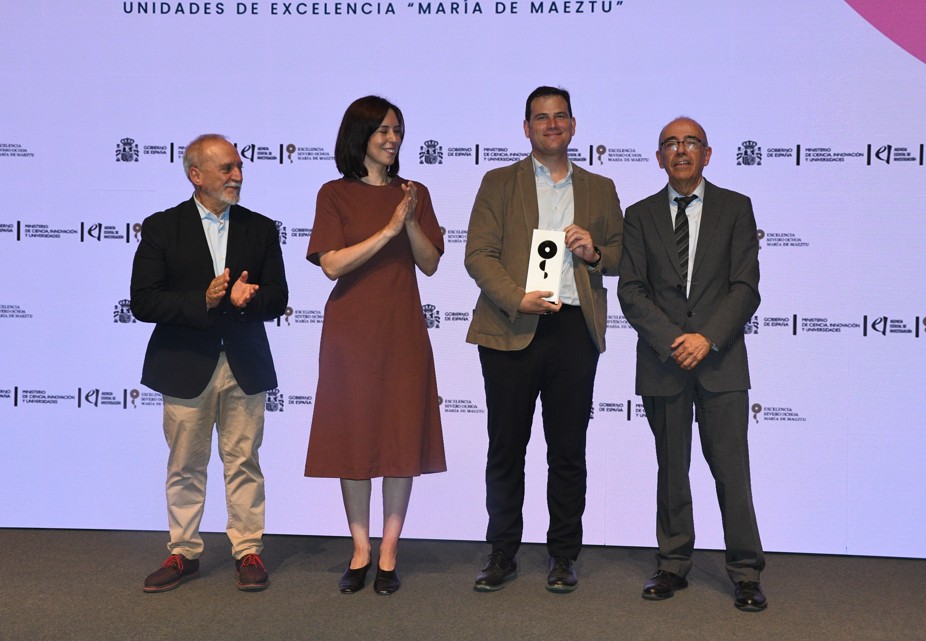
The accreditation ceremony was held at the Universitat Politècnica de València and was chaired by the Minister of Science, Innovation and Universities, Diana Morant, together with Juan Cruz Cigudosa, Secretary of State for Science, Innovation and Universities, and José Manuel Fernández de Labastida del Olmo, Director of the Spanish State Research Agency (AEI).
The CNIC was represented by Dr. Borja Ibáñez, Scientific Director of the CNIC, cardiologist at Hospital Universitario Fundación Jiménez Díaz in Madrid and group leader at the Spanish Biomedical Research Network in Cardiovascular Diseases (CIBERCV), and Dr. Vicente Andrés, Director of Basic Research and Principal Investigator of the Molecular and Genetic Cardiovascular Pathophysiology Group at the CNIC and CIBERCV.
The Severo Ochoa accreditation distinguishes Spanish research centres that stand out for the quality and international impact of their scientific results, their leadership, their ability to attract talent and their contribution to the advancement of knowledge. Selection takes place through a competitive process and an independent evaluation conducted by an international scientific committee made up of internationally renowned researchers.
This new award follows the accreditations previously obtained by the CNIC in the 2011, 2015 and 2020 calls and consolidates the centre’s position as one of Spain’s leading international institutions in cardiovascular research.
A strategy to improve cardiovascular health through comprehensive prevention
The Severo Ochoa Strategic Plan 2026–2030 aims to improve cardiovascular health by generating scientific knowledge and ensuring its effective translation into the prevention, diagnosis and treatment of cardiovascular diseases.
The strategy is based on the integration of basic and clinical research and proposes a new model of international collaboration that will combine the capabilities of the CNIC with those of centres of excellence in the United Kingdom and Germany.
These partnerships will be structured around four major scientific areas:
Digital health to improve cardiovascular prevention, through the use of wearable devices and digital biomarkers, as well as artificial intelligence to make advanced imaging and its interpretation more widely accessible.
Preventive regenerative therapies, aimed at intervening during the early stages of myocardial damage before it progresses to heart failure.
Cardiometabolic disease, with the objective of understanding the cardiovascular alterations that emerge before a diagnosis of prediabetes or diabetes.
Cardiovascular and brain health, with the objective of identifying the mechanisms linking cardiovascular risk factors and atherosclerosis with cognitive decline and dementia.
The projects will be carried out in collaboration with British Heart Foundation (BHF) and Medical Research Council (MRC) centres of excellence linked to King’s College London and the Universities of Edinburgh and Oxford, as well as with CARDDIAB, a German federal centre of excellence associated with Heinrich Heine University Düsseldorf.
Artificial intelligence and digital health
One of the main pillars of the new plan will be the creation of a Department of Digital Health and Artificial Intelligence, conceived as a cross-cutting structure that will support the different scientific areas of the CNIC.
The department will promote the incorporation of artificial intelligence, advanced data analysis, digital tools and biomedical imaging into research projects, clinical trials, training activities and the management of the centre.
Planned actions include the development of cardiovascular risk prediction models, the identification of digital biomarkers through smartphones and wearable devices, the automated analysis of medical images and the integration of clinical, genetic and molecular information with data related to lifestyle habits.
The strategy also includes expanding the CNIC’s high-performance computing capacity and strengthening the infrastructure required to securely process large volumes of data from population studies such as PESA and REACT.
Ten new predoctoral contracts
The funding awarded will enable the recruitment of ten predoctoral researchers, who will carry out their doctoral theses in priority areas of the CNIC Strategic Plan.
Each contract is supported by funding of €134,200 to cover employment costs and expenses associated with training stays at Spanish or international research centres. These grants are intended to train a new generation of scientists in strategic areas and facilitate their mobility and specialisation.
The CNIC will also strengthen its training programmes in artificial intelligence, multiomics, imaging, FAIR data, open science, ethics, cybersecurity, equality and technology transfer. It will also promote researcher exchanges and joint doctoral and postdoctoral programmes with its international partner institutions.
Attracting talent and supporting generational renewal
The Strategic Plan also includes new initiatives to attract young researchers with international experience and support generational renewal. These include the launch of the Trampoline programme, which will offer three-year contracts, renewable for a further three years, to young researchers with the potential to develop independent scientific programmes.
Researchers recruited through this programme will carry out projects related to the four research areas of the Severo Ochoa Strategic Plan 2026–2030.
From scientific discovery to patients
Another priority will be to accelerate the translation of scientific results into clinical practice and the healthcare system. The CNIC will strengthen the development of patents with high application potential, collaboration with biotechnology, pharmaceutical and medical technology companies, and participation in international consortia focused on the development of new diagnostic methods, medical devices and treatments.
The plan includes the creation of a research team specialising in interventional cardiology, including structural interventions, an area with the potential to generate innovations in valves, stents and other cardiovascular devices.
Artificial intelligence-based tools will also be developed to analyse and measure the influence of CNIC research on clinical guidelines, healthcare practice, health policies and population health.
An international cardiovascular research network
The accreditation will make it possible to establish a stable scientific collaboration network with leading European institutions. The programme will include joint projects, researcher exchanges, internal calls to fund pilot studies and specialised scientific meetings.
The CNIC will also join the International Cardiovascular Research Partnership Awards programme, led by the British Heart Foundation (BHF) in collaboration with the Dutch Heart Foundation (DHF), the German Centre for Cardiovascular Research (DZHK) and the Lefoulon-Delalande Foundation (LDF) in France.
This initiative promotes the creation of consortia and the development of joint cardiovascular research projects involving investigators from several countries.
With the CNIC’s participation, Spain will join the United Kingdom, Germany, France and the Netherlands in this initiative, strengthening the ability of Spanish researchers to lead international scientific projects.
Open science, equality and scientific integrity
The Strategic Plan 2026–2030 reinforces the CNIC’s commitment to open science, data management in accordance with the FAIR principles—findable, accessible, interoperable and reusable—as well as ethics, scientific integrity and information security. It also includes measures to advance the centre’s alignment with new European cybersecurity standards.
Equality and diversity, principles that are fully embedded in the CNIC’s activities and established institutional policies, will also be addressed as cross-cutting priorities throughout the programme. Within this framework, the centre will continue to promote greater representation of women in leadership positions, apply equality criteria in recruitment and selection processes and systematically incorporate sex as a biological variable in research whenever relevant.
About the Severo Ochoa and María de Maeztu accreditations
The Severo Ochoa Centres of Excellence and María de Maeztu Units of Excellence accreditations are awarded by the Spanish Ministry of Science, Innovation and Universities and managed by the Spanish State Research Agency.
These distinctions recognise research centres and units that carry out competitive, frontier scientific programmes and rank among the leading international institutions in their respective fields.
The grants are intended to strengthen their scientific capabilities, promote the attraction and training of talent, improve strategic organisation and increase the international leadership and visibility of science conducted in Spain.