Eight of Spain’s top sixth-form students begin their research training at the CNIC thanks to the ACÉRCATE programme


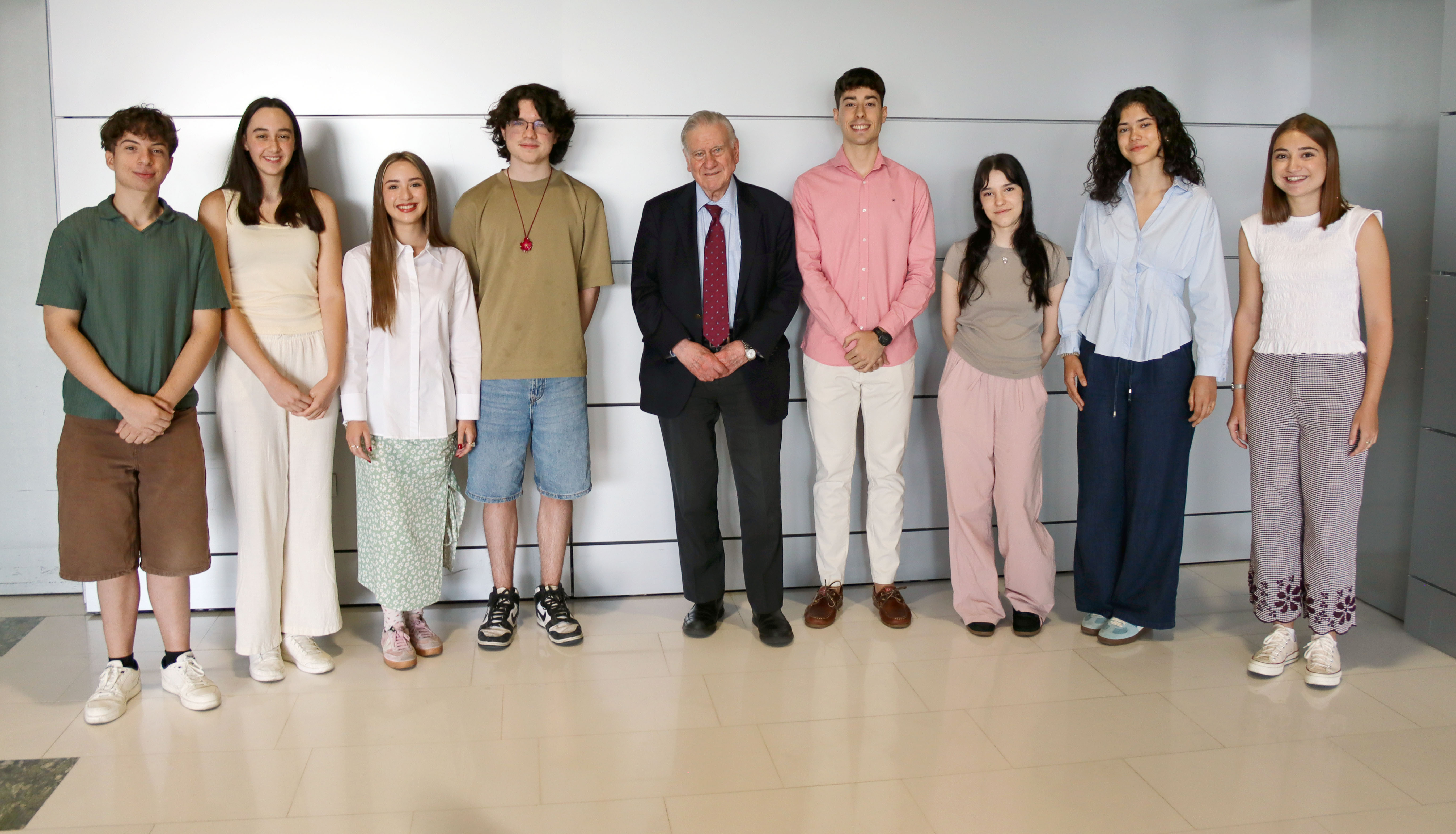
The aim of the Acércate Programme is to train the brightest young people from a very early age in order to build a pool of outstanding researchers in the field of cardiovascular research
Eight of Spain’s top sixth-form students have taken part in the ACÉRCATE programme, organised by the Carlos III National Centre for Cardiovascular Research (CNIC) as part of its CNIC-Joven Training Scheme. This programme is a personal initiative of Dr Valentín Fuster, the centre’s director-general, and its aim is “to attract and train the brightest young people from a very early age in order to create a pool of outstanding researchers in the field of cardiovascular research”.
The eight students selected this year represent emerging talent from various Spanish autonomous communities and share a common trait: an enormous scientific curiosity and a desire to dedicate their professional future to biomedical research.
Hailing from Galicia, Extremadura, Madrid, Castile and León, and the Valencian Community, they all stand out for their excellent academic records and for having previously taken part in scientific projects, Olympiads or educational enrichment programmes, including study abroad experiences. Including those from this intake, a total of 144 students have now taken part in the programme.
As in previous years, the ACÉRCATE programme also featured the winner of the CNIC–EUCYS Prize, awarded at the European Union Contest for Young Scientists (EUCYS). This year, the students were joined by Artūras Makselis, a student of Molecular Biology and Chemistry at Vilnius University (Lithuania), who won an award in 2025 for his project “Molecular Targets for Antiviral Therapy of Intestinal Infections”.
During his stay at the CNIC, he shared his research experience and his track record in international science competitions with the participants, as well as taking part in the programme’s activities.
A programme to inspire vocations
ACÉRCATE serves as the gateway to the CNIC-Joven training programme, which supports students from A-levels through to PhD level with the aim of nurturing a pool of future researchers.
The programme is supported by the Pro CNIC Foundation, whose backing makes it possible to sustain this initiative for the early identification of scientific talent. “Bringing research closer to young people means offering them the opportunity to discover that behind every medical advance there are people conducting research to improve patients’ lives,” concludes Dr Fuster.
Click here to view the photo album for this event
The participants are:
Carla Acosta García – IES Mendiño, Pontevedra

Carla hopes to study biomedicine at the Karolinska Institutet (Sweden); she wants to find out how a world-class research laboratory operates and discover the various career paths available in biomedical research.
Adriana Bravo Arribas – IES Cervantes, Madrid

Adriana, a prospective Biotechnology student at the Polytechnic University of Madrid, she is particularly interested in the application of artificial intelligence and data science to biomedical research.
Eva Freire Seoane - Colegio Diocesano San Ignacio, Ponferrada

Eva, who will be studying Biomedical Engineering at ICAI-Pontificia Comillas University, seeks to understand how engineering can help to unravel the biological mechanisms underlying diseases.
Fernando Juez Pozo - IES Rodríguez Moñino, Badajoz

Fernando, a prospective medical student, he hopes to gain an insight into the work of researchers and discover how scientific advances ultimately lead to improvements in patient care.
Pablo Linares Muñoz - IES La Senda, Quart de Poblet, Valencia
Pablo, also interested in medicine, believes that research is an essential tool for understanding the mechanisms of disease and developing new treatments.
Iago López Fernandez - IES Pintor Antonio López, Tres Cantos, Madrid

Iago is interested in physics and mathematics and would like to explore different areas of research and find out how scientists work at an international centre such as the CNIC.
Laura Ungureanu Badenas - Colegio Mater Dei, Castellón

Laura, who is set to begin a dual degree in Biotechnology and Chemistry, hopes to specialise in regenerative medicine and targeted therapies for cardiovascular diseases.
Claudia Yañez Machi - Colegio Sagrado Corazón Hermanos Maristas, Valencia

Claudia, a prospective student of Medical and Pharmaceutical Biotechnology in Austria, she hopes to gain practical laboratory experience and understand how research is transformed into medical innovation.