European Journal of Heart Failure: A diabetes drug reduces complications after aortic valve replacement


A new analysis of the DapaTAVI trial, published in the European Journal of Heart Failure, confirms that dapagliflozin improves outcomes after TAVI regardless of cardiac function.
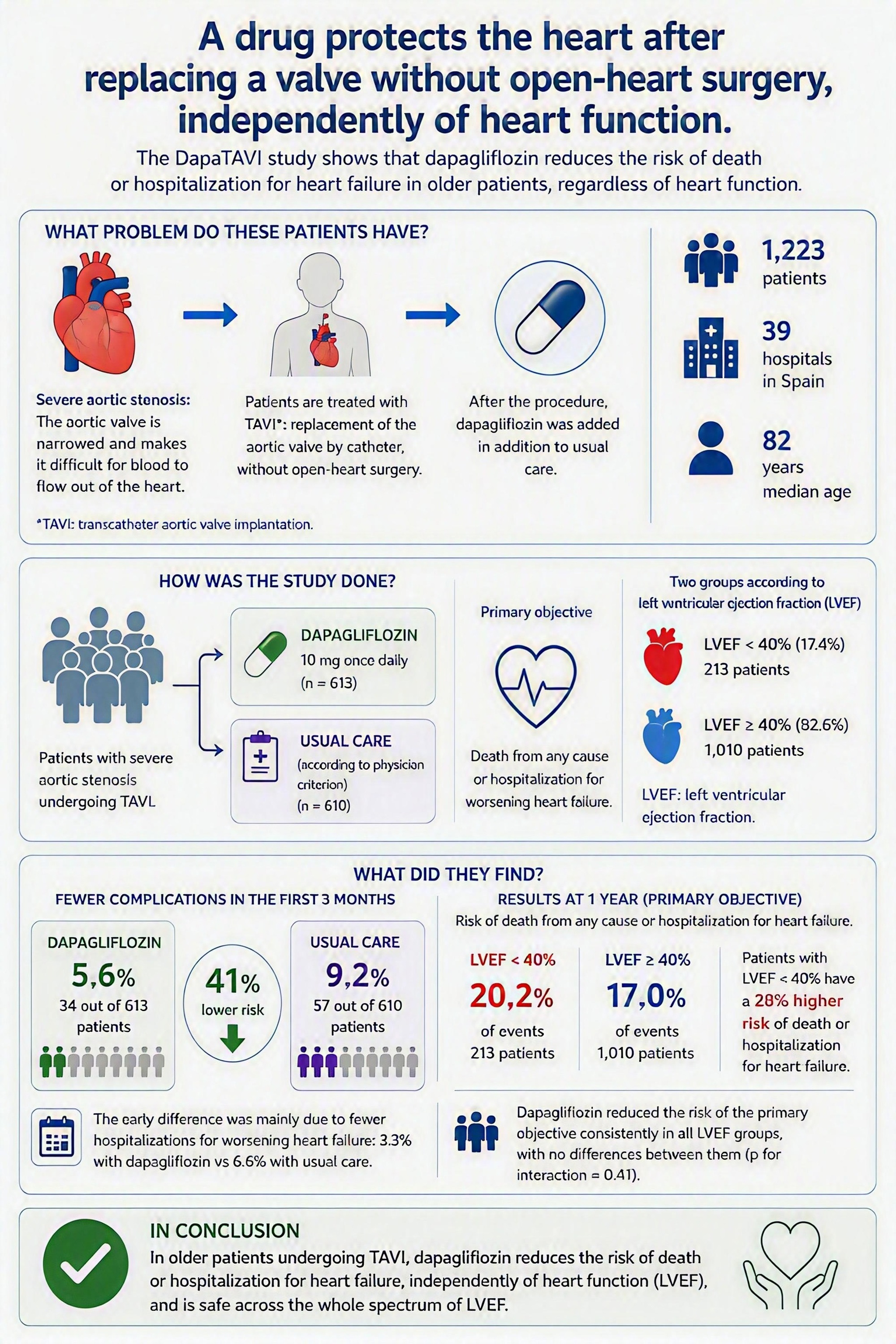
A new analysis of the DapaTAVI clinical trial, coordinated by researchers at the Centro Nacional de Investigaciones Cardiovasculares Carlos III (CNIC) and the Spanish Society of Cardiology, shows that dapagliflozin—a drug used to treat type 2 diabetes—continues to benefit patients with severe aortic stenosis undergoing transcatheter aortic valve implantation (TAVI), regardless of their left ventricular ejection fraction, one of the most widely used measures of the heart's pumping capacity.
The results, published in the European Journal of Heart Failure, build on the original DapaTAVI findings reported inThe New England Journal of Medicine, which showed for the first time that dapagliflozin reduces the risk of death or worsening heart failure in patients with severe aortic stenosis treated with TAVI. TAVI is a minimally invasive procedure that implants a new valve via catheter, avoiding major surgery.
“Until now, we knew that dapagliflozin improved outcomes in patients undergoing TAVI. We have now shown that this benefit is maintained both in patients with reduced ventricular function and in those with preserved function,” explains Dr. Borja Ibáñez, CNIC Scientific Director, cardiologist at Hospital Universitario Fundación Jiménez Díaz, and group leader in the Spanish cardiovascular research network (CIBERCV).
Aortic stenosis is one of the most common valvular heart diseases in older adults. Although TAVI has revolutionized the treatment of this condition, a substantial proportion of patients continue to experience heart failure, recurrent hospitalizations, and a high risk of mortality after the procedure.
Sodium-glucose cotransporter 2 (SGLT2) inhibitors such as dapagliflozin have demonstrated cardiovascular and renal benefits in multiple clinical trials. However, patients with severe valvular disease had been systematically excluded from these studies, leaving a major gap in clinical knowledge.
“Patients with severe aortic stenosis had consistently been excluded from the large SGLT2 inhibitor trials. DapaTAVI is helping to close an important gap in clinical cardiology,” says Dr. Sergio Raposeiras-Roubín, a researcher at Hospital Universitario Álvaro Cunqueiro in Vigo, a CNIC scientist, and coordinator of the study.
The new analysis included 1,223 patients with severe aortic stenosis treated with TAVI at 39 Spanish hospitals. Of these, 17.4% had reduced ejection fraction (≤40%), while the remainder had ventricular function above 40%.
Pacientes mayores
After one year of follow-up, the researchers found that dapagliflozin consistently reduced the combined risk of all-cause death or worsening heart failure across all groups analyzed. Statistical analyses showed that the beneficial effect of treatment was maintained throughout the entire range of ventricular function, with no significant differences between patients with reduced and preserved ejection fraction.
“This analysis demonstrates that the benefits of dapagliflozin after transcatheter aortic valve implantation do not depend on the heart’s pumping function,” says Raposeiras-Roubín.
“One of the most important findings is that the benefit appears very soon after the procedure. During the first months, we observed a marked reduction in heart failure episodes, precisely the period of greatest vulnerability for these patients,” notes Dr. Ignacio Amat-Santos, a researcher at Hospital Clínico Universitario de Valladolid and the CNIC, and a coauthor of the study.
Another important finding is that treatment was also shown to be safe in very elderly patients, given that the average age of participants was 82 years, considerably older than the populations included in most previous SGLT2 inhibitor trials.
“Demonstrating efficacy and safety in this patient group has enormous clinical relevance,” says Dr. Valentín Fuster, CNIC General Director and coauthor of the study.
The researchers emphasize that these findings reinforce a broader idea: the cardiovascular benefits of dapagliflozin go beyond traditional ejection-fraction categories, acting instead through core cardiorenal mechanisms that drive heart failure progression.
“These results strengthen the idea that the cardiovascular benefits of SGLT2 inhibitors go beyond the traditional ejection-fraction categories and act through key mechanisms involved in heart failure,” says Dr. Ibáñez.
According to Dr. Ibañez, “We have very few pharmacological therapies that have been shown to improve outcomes after TAVI. Dapagliflozin is emerging as a simple, safe option that could potentially be used in the great majority of these patients.”
The authors conclude that the findings support the incorporation of dapagliflozin into the routine management of patients after TAVI, regardless of baseline ventricular function.
The DapaTAVI study received funding from the Carlos III Health Institute (FIS project PI19/01882), the Castilla y León Regional Health Authority (GRS 2459/A/21), the Spanish Society of Cardiology (SEC/FEC-INV-CLI 21/004), the Galician Society of Cardiology (SOGACAR 2022), and the European Commission through the SGLT2-HYPE project (Grant Agreement 101156555).