CNIC and Fundación AstraZeneca bring together young scientists and European leaders in Madrid to advance the “SAFE HEARTS PLAN”


The meeting forms part of European awareness-raising activities around the European Commission’s new strategy to strengthen prevention, early detection, and management of cardiovascular disease
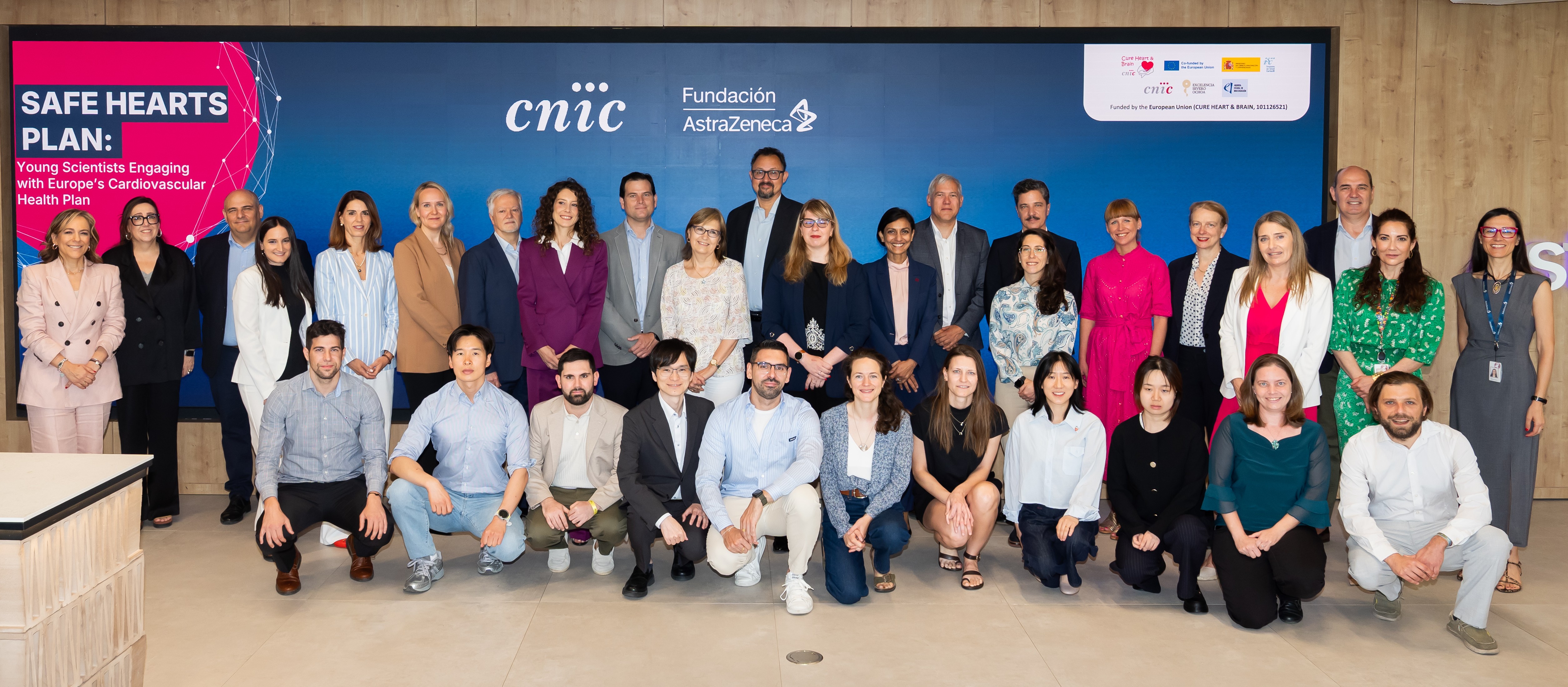
The Centro Nacional de Investigaciones Cardiovasculares Carlos III (CNIC) and the AstraZeneca Foundation, with the participation of the European Society of Cardiology (ESC), today hosted the international meeting “SAFE HEARTS PLAN: Young Scientists Engaging with Europe’s Cardiovascular Health Plan” in Madrid.
The event brought together early career researchers, policymakers, clinicians, institutional representatives, industry stakeholders, and patient organizations from more than 15 countries to discuss the future of cardiovascular health in Europe and, in particular, how to accelerate the translation of scientific evidence into public policies and measurable changes in healthcare practice.
The meeting formed part of European outreach and awareness-raising activities linked to the SAFE HEARTS PLAN, the European Commission’s new strategy to strengthen prevention, early detection, and management of cardiovascular diseases across Europe.
Held in a hybrid format, the event aimed to connect new generations of scientists—especially early career researchers and healthcare professionals—with the European cardiovascular health framework. The initiative promoted practical dialogue across research, digital innovation, prevention, clinical practice, and public health.
The meeting was opened by Dr. Valentín Fuster, General Director of the CNIC, and Marina Pollán, Director of the Carlos III Health Institute (ISCIII), and was closed by Dr. Borja Ibáñez, CNIC Scientific Director.
In his remarks, Dr. Fuster highlighted the importance of engaging young scientists in European priorities: “At the CNIC, we are fully committed to this effort. The message for young researchers is clear: your work can help shape not only the future of science, but also the future of cardiovascular health in Europe.” He also stressed the CNIC’s contribution through major European initiatives such as JACARDI, which aims to improve the prevention and management of cardiovascular disease and diabetes across Europe through collaboration, implementation, and knowledge exchange.
Marta Moreno, Vice President of the Fundación AstraZeneca and Head of Corporate Affairs and Market Access at AstraZeneca Spain, underlined the scale of the challenge: “Cardiovascular disease is the leading cause of death in Europe, responsible for 10,000 deaths every day, more than two out of every five deaths, and costing the EU economy €282 billion annually.” She added: “We need to translate Europe’s excellent cardiovascular science into prevention and early detection that reach clinical practice equitably and at scale. That is why the Fundación AstraZeneca strongly supports the European Commission’s SAFE HEARTS PLAN as a key initiative to drive a coordinated, ambitious, and sustainable response to cardiovascular disease in Europe.”
Young researchers at the center of the dialogue
A defining feature of the meeting was the leading role of young researchers from the CNIC’s European Cure Heart and Brain MSCA COFUND program, who participated as speakers and moderators. The format enabled direct interaction with decision makers and key stakeholders, highlighting the importance of translational research in advancing prevention, early detection, equity, and implementation at the European level.
Throughout the day, participants examined the main challenges in reducing the burden of cardiovascular disease in Europe and agreed on the need to strengthen large scale implementation of existing strategies by integrating science, healthcare practice, and public policy.
Discussions emphasized the importance of reinforcing cardiovascular prevention from a population perspective, addressing risk factors, and promoting measures that act before major events occur. Participants stressed that European strategies must translate into sustainable interventions within healthcare systems.
A central theme was how digital innovation, including artificial intelligence, can support early detection, monitoring, and evaluation of cardiovascular health strategies, provided this is underpinned by robust health data governance, interoperable systems, and strong standards for trust and protection.
The meeting also addressed inequalities in disease burden and access to prevention, highlighting the need to incorporate equity as a key indicator of success, measuring not only activity but outcomes, and with particular attention to vulnerable populations.
Panelists agreed that the main challenge is no longer simply to generate evidence, but to translate that evidence into actionable policies supported by funding, accountability mechanisms, common indicators, and clearly defined care pathways linking detection, referral, treatment, and follow up.
International expert participation
The event featured contributions from leading experts including Antonio Parenti: (European Commission, DG SANTE), Kitti Almer (ESC), Héctor Bueno (CNIC and ESC committee), Aleida Alcaide (Spanish Ministry for Digital Transformation), Andreas Heddini (AstraZeneca), Folkert Asselbergs (ESC AI Chair), Birgit Beger (EHN), Sonya Babu Narayan (BHF), Cristina Pérez Herreras (Banco Santander), and Benedetta Armocida (JACARDI), among others. Representatives from institutions such as the Finnish Institute for Health and Welfare (THL), ALCER, and the Royal Danish Embassy in London also participated.
The launch of the SAFE HEARTS PLAN by the European Commission at the end of last year marked a major step forward in improving cardiovascular health across the EU. The initiative positions cardiovascular health management as an economic and competitiveness priority, recognizing the broad social and productivity impacts of cardiometabolic diseases, and provides member states with a structured framework for implementing or strengthening national cardiometabolic risk assessment programs through early diagnosis.
Take a look at the photo album: https://flic.kr/s/aHBqjCWKNw