The CNIC strengthens its leadership in cardio-oncology through a prominent presence at CardioTox 2026


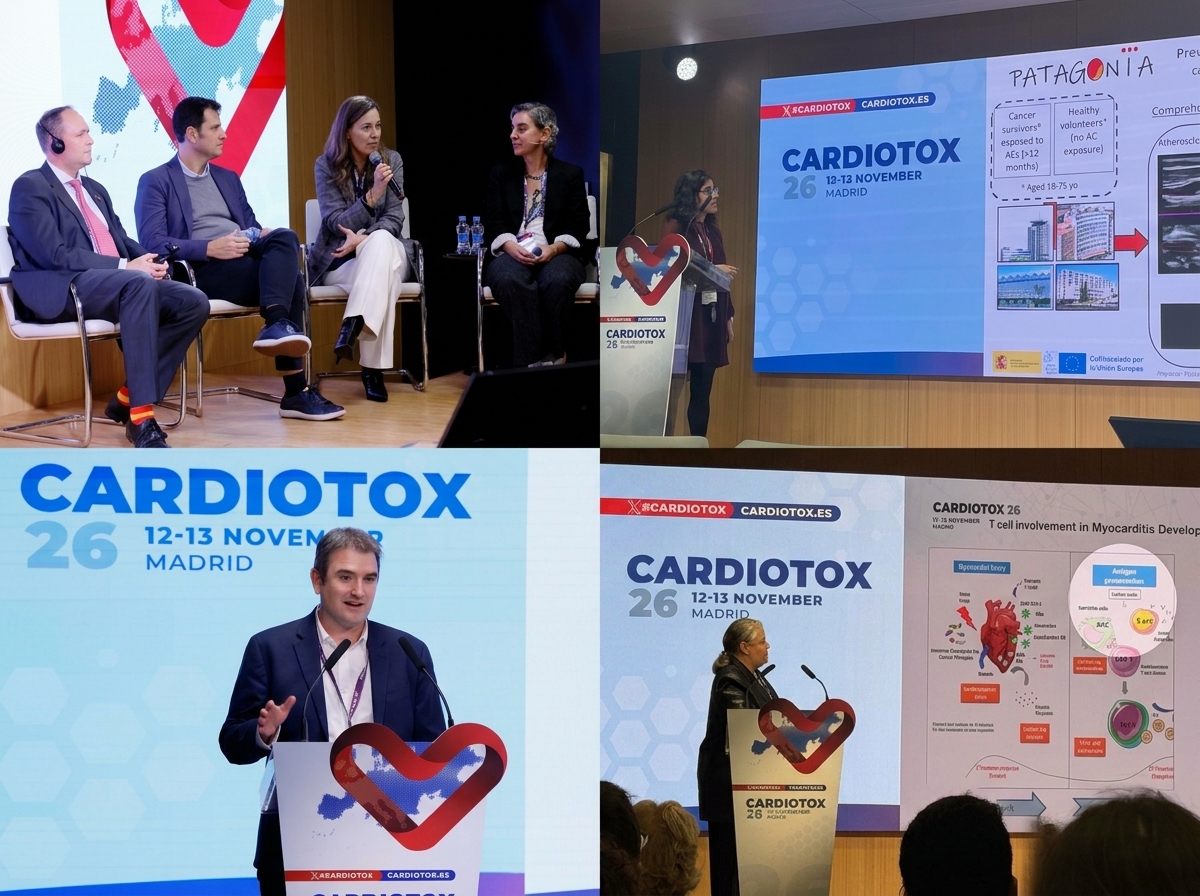
The CNIC once again had a prominent presence at CardioTox 2026, one of the leading international cardio-oncology meetings held in Spain, which has established itself as a benchmark forum for advancing the prevention, diagnosis, and treatment of cardiovascular complications associated with cancer and its therapies.
The meeting, held in Madrid and led by Teresa López-Fernández, Raúl Córdoba, Isabel Rodríguez, and Álvaro Pinto, brought together national and international specialists in cardiology, oncology, hematology, and biomedical research to discuss the main scientific and clinical advances in this discipline.
For another year, CNIC researchers played a leading role in the scientific program. Dr. Borja Ibáñez, Scientific Director of the CNIC, served on the Scientific Committee of the congress, which has become one of Europe's leading forums for discussing the present and future challenges of cardio-oncology.
Through presentations, panel discussions, and moderating roles, the center's researchers shared some of the most relevant breakthroughs developed at the CNIC in areas such as cardiac immunotoxicity, cardiovascular imaging, clonal hematopoiesis, and translational medicine applied to cancer patients.
Researcher Pilar Martín addressed the molecular and cellular mechanisms that trigger cardiotoxicity in cancer patients treated with immune checkpoint inhibitors (ICIs). Dr. Martín, head of the Regulatory Molecules of Inflammatory Processes group, focused on how immunological tolerance is lost following ICI treatment, activating potential autoreactive T-cell clones against cardiac antigens and triggering inflammatory responses in the heart.
For her part, Dr. Inés García-Lunar, who spoke during the imaging in cardio-oncology session, highlighted the CNIC's well-established line of research studying the long-term cardiovascular consequences of cancer treatments. Dr. García-Lunar, head of the Imaging-Based Cardiovascular Prevention group, noted that although therapeutic advances have significantly improved survival after cancer, "many patients develop cardiovascular problems that can manifest years or even decades later."
Traditionally, surveillance has focused on detecting cardiotoxicity during treatment, particularly heart muscle dysfunction. However, the cardiovascular risk for these patients goes further, and imaging techniques can help us understand what is happening in the heart and blood vessels over time.
The CNIC researcher presented the PATAGONIA and LURK projects, which are being developed at the center to investigate the long-term cardiovascular effects of cancer treatments beyond conventional measures of ventricular dysfunction through the use of advanced cardiovascular imaging. Her presentation was complemented by moderating a session focused on cardiac damage induced by cancer therapies, one of the most clinically relevant issues today.
José Javier Fuster, head of the Hematovascular Pathophysiology group at the CNIC, highlighted the role of clonal hematopoiesis of indeterminate potential (CHIP)—a process in which certain hematopoietic stem cells acquire mutations and expand—as a major modifier of cardiovascular risk in cardio-oncology. Dr. Fuster explained how some cancer treatments can promote the expansion of these mutant clones and provided key insights into their link to the development of cardiovascular complications in both cancer patients and survivors.
The congress also dedicated a session to the future of cardio-oncology and defining research priorities for the coming years. Drs. Raúl Córdoba and Teresa López-Fernández moderated a debate focused on the scientific and healthcare challenges of the specialty, featuring Dr. Borja Ibáñez, Dr. Alexander Lyon, and Dr. Laura Montero.
The speakers analyzed the roadmap needed to accelerate the integration of new evidence into clinical practice, foster international collaborative research, and improve cardiovascular care for people with cancer.
CNIC Scientific Director Dr. Borja Ibáñez focused his presentation, Translational Research Priorities in Cardio-Oncology, to analyzing how to translate laboratory findings into clinical practice to prevent cardiotoxicity before it becomes irreversible.
Dr. Ibáñez presented the primary cardioprotection and personalized medicine strategies driven by the CNIC and major European consortia in which the center actively participates. Among them, he highlighted RESILIENCE, focused on remote ischemic conditioning to protect the heart against anthracyclines; COMPASS and GRACE, aimed at improving risk stratification and validating new diagnostic and therapeutic tools; as well as initiatives like MATRIX, designed to promote early detection, advanced cardiovascular imaging, and personalized care for oncology patients.
The GRACE project had a dedicated session at the congress exploring hybrid care models and their potential to transform cardio-oncology practice.
The CNIC's participation in CardioTox 2026 underscores the center's leadership in translational cardio-oncology research and its commitment to collaborative European initiatives aimed at advancing early detection, cardioprotection, and personalized medicine. Through these efforts, the CNIC contributes to developing new strategies to protect the cardiovascular health of people with cancer during treatment and throughout survivorship.