Science Immunology: Mitochondria control immune cell activation and the effectiveness of immunotherapy


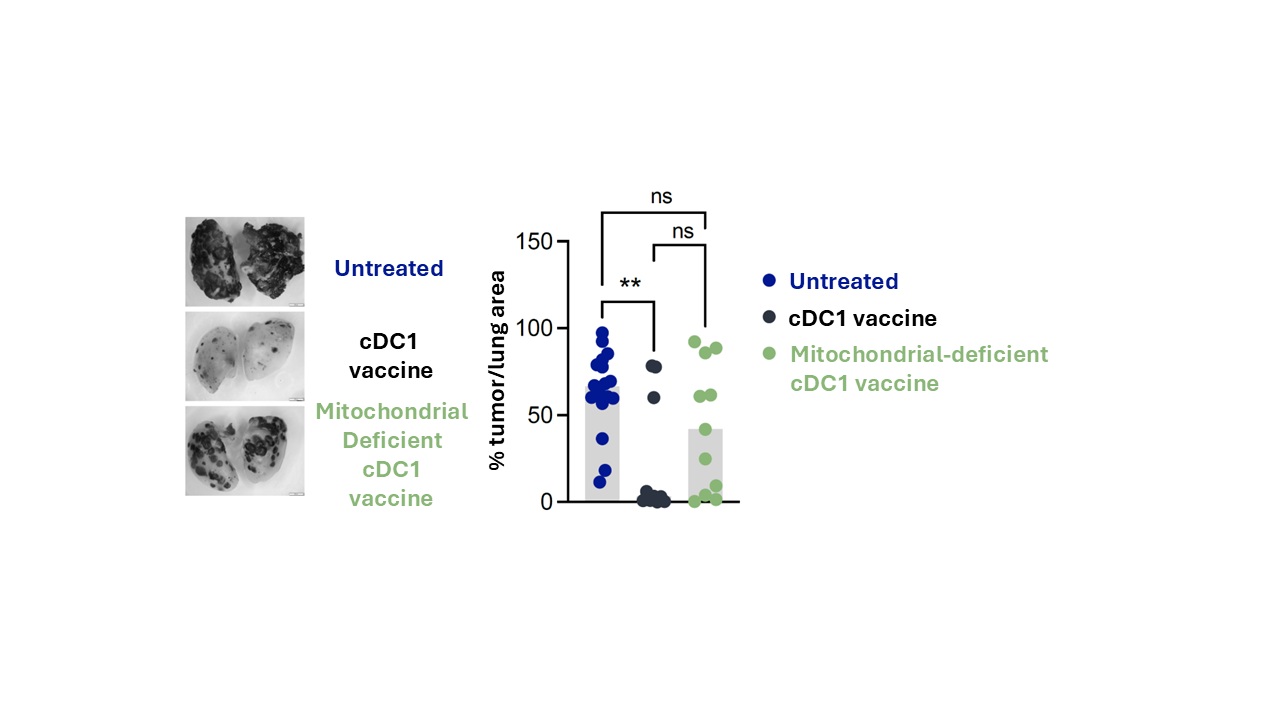
A CNIC-led study identifies a mitochondrial “checkpoint” that enables dendritic cells to efficiently activate T lymphocytes against viruses and tumors
A study led by researchers at the Centro Nacional de Investigaciones Cardiovasculares (CNIC) has identified a mitochondrial “checkpoint” that enables dendritic cells to efficiently activate T lymphocytes against viruses and tumors. Dendritic cells are immune cells that detect threats and activate the body’s defenses, acting as “sentinels” that instruct T lymphocytes on what to attack.
The study, published in Science Immunology, shows that restoring the internal chemical imbalance caused by defective mitochondrial function in dendritic cells restores the capacity of immune cells to defend the body against infection. The findings could open new avenues for improving cancer immunotherapy.
The study reveals that the ability of dendritic cells to activate T lymphocytes depends on an unexpected mechanism: the proper functioning of mitochondrial complex I, a key mitochondrial component. Mitochondrial complex I acts as a “metabolic switch” that is essential for the ability of dendritic cells to convert viral or tumor-derived material into effective immune activation signals and trigger a strong T-cell response.
The study, led by David Sancho, a researcher at the CNIC, and Michel Enamorado, at the Icahn School of Medicine at Mount Sinai, New York, identifies a new metabolic checkpoint that determines the effectiveness of this immune “instruction” process.
“We discovered that mitochondrial complex I acts as a genuine metabolic switch. Without its proper function, dendritic cells lose much of their ability to activate T lymphocytes to fight threats such as tumors or viruses,” explains Dr. Sancho.
The study’s two co-first authors, Sofía C. Khouili and Elena Priego (CNIC), emphasize that mitochondrial complex I function is critical for dendritic-cell-mediated activation of T lymphocytes.
Mitochondrial complex I
Sofía C. Khouili explains that “when complex I function is impaired, dendritic cells struggle to present sufficient antigen to T lymphocytes, reducing both T cell activation and the immune response against viruses or tumors.”
Elena Priego adds that “the key lies in the increased NADH-to-NAD+ ratio that results from complex I deficiency. Rebalancing this ratio by pharmacological means restores the ability of dendritic cells to activate T lymphocytes during viral infections or antitumor responses.”
According to Drs. Sancho and Enamorado, mitochondrial activity in dendritic cells can become altered in certain settings, such as the tumor microenvironment, limiting their ability to activate T lymphocytes. “We identified mitochondrial complex I in dendritic cells as a key checkpoint and demonstrated that correcting the internal chemical imbalance associated with its dysfunction can restore immune responses in experimental models.”
The researchers conclude that these findings “point toward new strategies for enhancing vaccines and cancer immunotherapies.
E.P. was funded through the Predoctoral Contracts for the Training of Doctors 2017 program (Reference: BES-2017-079717). Metabolomics Workbench (68) is funded by NIH grants U2C-DK119886 and OT2-OD030544. Research conducted in the DS laboratory is funded by the CNIC; by the Ministry of Science, Innovation and Universities (MICIU) grants PID2022-137712OB-I00, PDC2025-165319-I00, CPP2022-009762, and CPP2024-011365 MICIU/AEI/10.13039/501100011033 State Research Agency, European Union NextGenerationEU/PRTR; by the Community of Madrid (P2022/BMD-7333 INMUNOVAR-CM); by the Scientific Foundation of the Spanish Association Against Cancer (AECC-PRYGN246642SANC); by Worldwide Cancer Research WWCR-25-0080; by the CRIS Foundation (excellence2025_03); and by the “la Caixa” Foundation (LCF/PR/HR23/52430012 and LCF/PR/HR22/52420019). Research in M.E.’s laboratory is funded by a seed package from the Icahn School of Medicine at Mount Sinai (Sinai Cloud Fund #IS127201039). The CNIC is funded by the Instituto de Salud Carlos III (ISCIII), the MICIU, and the Pro CNIC Foundation, and is recognized as a Severo Ochoa Center of Excellence (CEX2020-001041-S funded by MICIU/AEI/10.13039/501100011033).