Circulation Research: A protein-degradation mechanism opens a new treatment route for an inherited arrhythmia


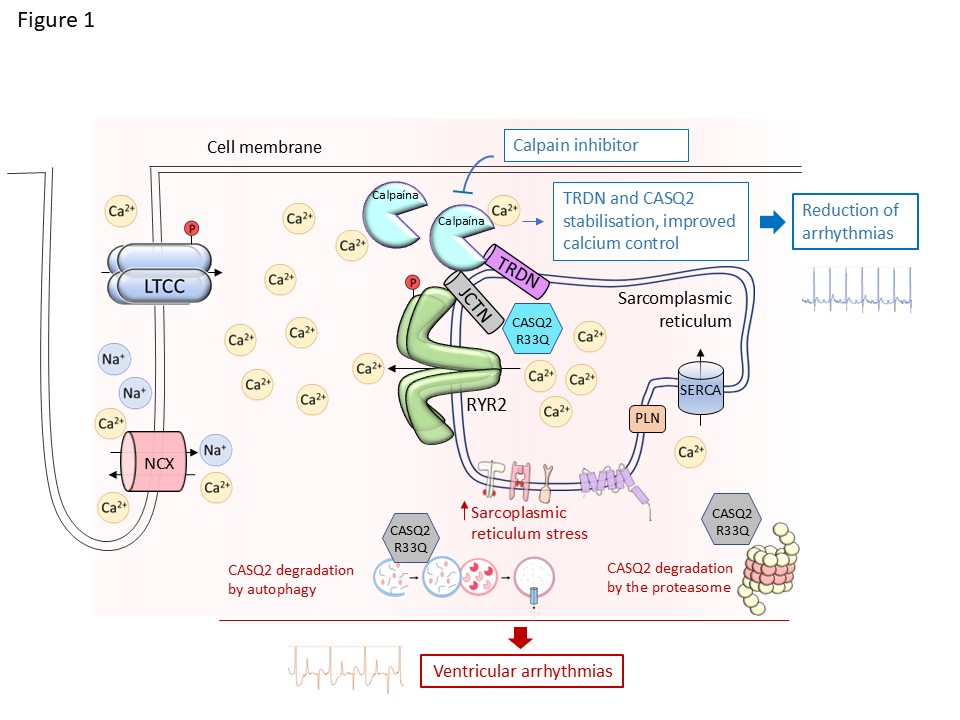
Researchers at the CNIC, in collaboration with the University of Pavia and IRCCS Istituti Clinici Scientifici Maugeri, have found that activation of the enzyme calpain contributes to the development of a severe inherited arrhythmia.
An international team has identified a protein-degradation mechanism that contributes to the development of an inherited form of catecholaminergic polymorphic ventricular tachycardia (CPVT), a disease that mainly affects children and young people. The study was led by researchers at the Centro Nacional de Investigaciones Cardiovasculares Carlos III (CNIC), in collaboration with the University of Pavia and IRCCS Istituti Clinici Scientifici Maugeri in Italy,
The study, published in the journal Circulation Research, also identifies a possible therapeutic strategy based on inhibiting the enzyme calpain. Researchers from the Spanish cardiovascular research network (CIBERCV) also took part in the study.
CPVT is an inherited life-threatening arrhythmic disease that can cause loss of consciousness and even sudden death, mainly in children and young adults. A particularly dangerous feature of the disease is that arrhythmias often appear during exercise or emotional stress, when the heart's activity increases.
The study, led by Dr. Enrique Lara-Pezzi, head of the Molecular Regulation of Heart Failure group at the CNIC, in collaboration with Dra. Silvia G. Priori of IRCCS Istituti Clinici Scientifici Maugeri and the University of Pavia, examined a form of CPVT caused by a mutation in the gene encoding calsequestrin, a protein that helps control calcium inside heart cells. Calcium is essential for the heart to contract in a coordinated way with every beat, and disruptions to its regulation can trigger abnormal heart rhythms.
Using a combination of proteomics techniques, experimental models, and cellular and biochemical studies, the team discovered that the problem does not end with the initial disruption of calcium handling. This abnormality, explains Dr. Lara-Pezzi, “activates various cellular degradation mechanisms that reduce the levels of essential proteins in the molecular complex responsible for regulating calcium release inside cardiomyocytes.”
One of the standout mechanisms involves the calcium-dependent enzyme calpain. The team showed that calpain activity is increased in the mutant animals and directly targets triadin (TRDN), a protein that helps to stabilize the calcium-release machinery.
The results also reveal a previously unknown sequence of events: degradation of triadin precedes the loss of mutant calsequestrin and contributes to its destabilization.
The researchers emphasize that pharmacological blockade of calpain restored several proteins of this machinery, improved calcium handling in heart cells, and reduced the occurrence of ventricular arrhythmias in mice with the disease.
“Our results identify protein degradation as an important mechanism contributing to the development of this form of CPVT, and show that calpain could represent a new therapeutic target,” says CNIC researcherDr. Laura Ramos-Hernández, first author on the study.
The authors nevertheless stress that these are preclinical results, and it will thus be necessary to determine whether this calpain-mediated degradation mechanism is also present in other forms of CPVT and in other cardiac diseases, and to carry out further studies before considering its possible translation into clinical practice.
The study was funded by the Pathfinder Cardiogenomics del European Innovation Council, through the DCM-NEXT project (101115416), and by project PID2024-155919OB-I00, funded by the Ministerio de Ciencia, Innovación y Universidades (MCIN/AEI/10.13039/501100011033), the European Union through NextGenerationEU/PRTR, and the ERDF. The study also received funding from the European Research Council (ERC; grant agreement 101142005) and from the Community of Madrid regional government, through CARDIOBOOST-CM (P2022/BMD-7245).