Circulation: Arrhythmia and Electrophysiology: Changes in the heart's electrical signals anticipate the most severe arrhythmias in heart failure patients



A CNIC-led study has developed a predictive model using the cardiac electrical signals remotely transmitted by implantable defibrillators to hospital during follow-up of heart failure patients
The heart gives warning signs. It does so through small electrical variations — signals so subtle that until now they went unnoticed among the millions of data points generated by implantable defibrillators. Today, thanks to remote analysis of the cardiac signal, these whispers can become an early warning.
A study led by the Centro Nacional de Investigaciones Cardiovasculares Carlos III (CNIC) has developed a cardiac electrical signal analysis model capable of identifying the periods when people with an implantable defibrillator are at greatest risk of a severe arrhythmia.
Thousands of heart failure patients currently carry an implantable cardioverter-defibrillator (ICD). Defibrillators detect and treat severe arrhythmias, sometimes via an electrical shock, in patients at risk of sudden death, including people with heart failure. Although they save lives, the shocks they generate are not without consequence, so knowing when a patient enters a period of greater vulnerability to this type of arrhythmia remains an unresolved need.
The research, published in Circulation: Arrhythmia and Electrophysiology, a leading American Heart Association journal in the field of heart rhythm disorders, shows that progressive changes in the electrical signals recorded by these devices — transmitted periodically and remotely to hospital — make it possible to dynamically determine the risk of ventricular fibrillation, the most dangerous cardiac arrhythmia.
This new research proposes a paradigm shift. Rather than simply reacting once an arrhythmia appears, the defibrillator could help anticipate when one is about to occur.
The team started from a simple premise: as heart failure worsens, pressure inside the heart rises, its walls stretch further, and the propagation of the electrical impulse is disrupted.
This hypothesis was tested in experimental animal models fitted with an implantable defibrillator. The experimental results showed that, as the disease progressed, the local electrical signal weakened and ventricular activation slowed. By the end of follow-up, these changes were associated with a far higher risk of ventricular fibrillation compared with the disease-free control group.
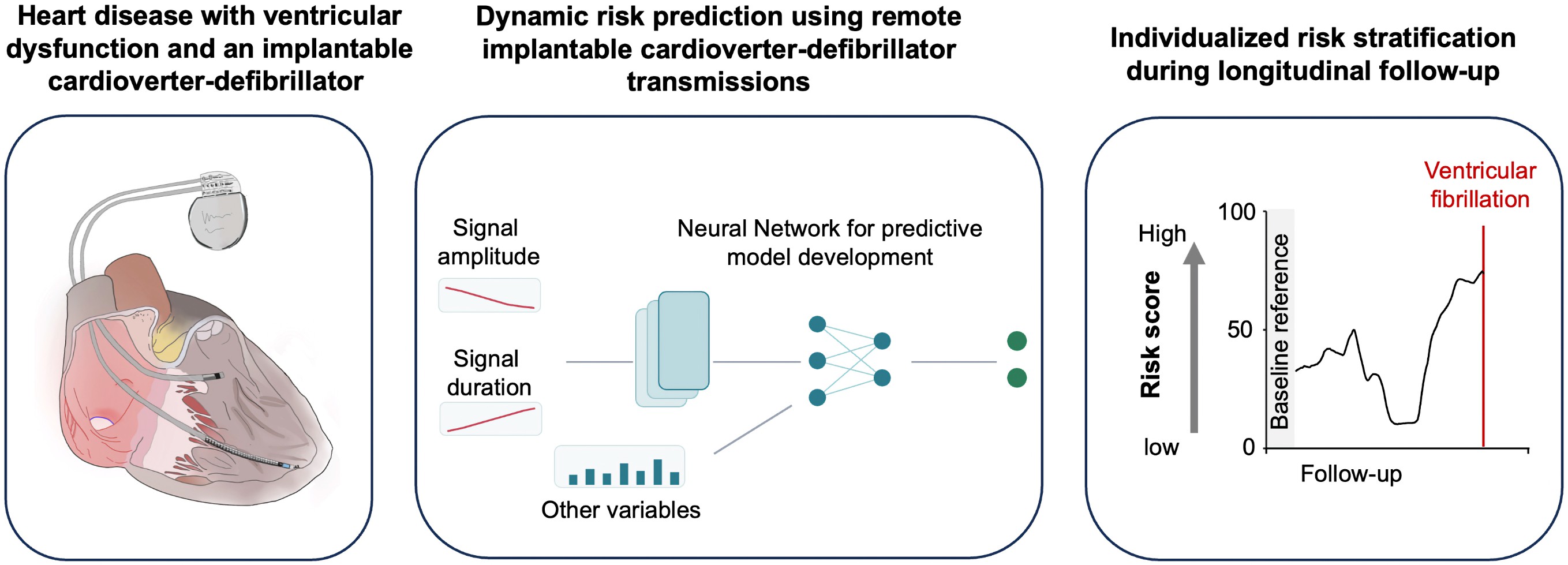
The researchers then used these findings to train a neural network (a type of artificial intelligence capable of recognizing patterns) using remote cardiac electrical activity recordings from 5,089 patients across 50 Spanish hospitals. The model was then validated across seven national centers in an independent cohort of 2,040 patients carrying devices from a different manufacturer. The model tracks the evolution of the electrical signal and of premature ventricular complexes (PVCs), generating a risk score from 0 to 100 that updates with each transmission. In patients who went on to have ventricular fibrillation, the score rose in the months before the event, while in the rest of the patients it remained stable.
The tool predicted arrhythmic events better than assessment based on clinical and demographic variables such as age or medical history.
“Unlike other algorithms, our model is grounded in the pathophysiology of heart failure, so its predictions carry a clinical meaning that physicians can interpret,” explains Dr. David Filgueiras-Rama, cardiologist at the Hospital Clínico San Carlos, Madrid; head of the CNIC Advanced Development in Arrhythmia Mechanisms and Therapy group and coordinator of the study.
Dr. Jesús Diz Díaz, a CNIC researcher and joint first author on the paper together with Dr. José María Lillo Castellano, of the Fundación Interhospitalaria para la Investigación Cardiovascular (FIC), notes that “the tool uses information that defibrillators already send to hospital, so it could be incorporated into remote monitoring platforms without the need to implant another device, which could help bring forward check-ups or adjust treatment during periods of higher risk.”
According to the authors, this advance opens the door to more personalized, preventive cardiology.
In future, specialists could receive automatic alerts when a given patient’s electrical profile shows a marked increase in risk. This would allow for more personalized care and earlier decision-making.
The significance of the study goes beyond the technology itself. The researchers have shown that the information needed to anticipate some potentially fatal arrhythmias is already present in the millions of remote transmissions that implantable defibrillators generate daily. The key lies in interpreting this information correctly.
This research was carried out in collaboration with the Fundación Interhospitalaria para la Investigación Cardiovascular (FIC); the Centro de Investigación Biomédica en Red de Enfermedades Cardiovasculares (CIBERCV, the Spanish biomedical research network on cardiovascular diseases); the Instituto de Investigación Sanitaria del Hospital Clínico San Carlos (IdISSC); the Instituto de Investigación Sanitaria de la Fundación Jiménez Díaz; Hospital Universitario La Paz; Universidad Complutense de Madrid; Universidad Autónoma de Madrid; the Instituto de Investigación en Ingeniería de Aragón at the Universidad de Zaragoza; the CIBER de Bioingeniería, Biomateriales y Nanomedicina (CIBER-BBN); Queen Mary University of London (UK); the Istituti Clinici Scientifici Maugeri in Pavia(Italy); and the cardiology departments of numerous of numerous Spanish hospitals participating in the UMBRELLA registry and in the validation cohort.
The study was funded by the European Union Horizon 2020 research and innovation programme (grant agreements No. 965286 and 874827); the AstraZeneca Foundation (6th Young Investigators Award); the Community of Madrid (S2022/BMD-7229, ARCADIA); the Spanish Ministry of Science and Innovation (MCIN) (PID2023-150456OB-I00) and the Spanish State Research Agency/10.13039/501100011033; the Instituto de Salud Carlos III (ISCIII) (PMP22/00185); Fundación Interhospitalaria para la Investigación Cardiovascular (FIC); the Heart Rhythm Association of the Spanish Society of Cardiology; and CIBERCV.
- Diz-Díaz J, Lillo-Castellano JM, La Rosa G, Soto-Pérez M, Martínez-Ferrer J, Ricoy E, et al. Dynamic risk assessment of severe ventricular arrhythmia in patients with implantable defibrillators and reduced left ventricular ejection fraction. Circ Arrhythm Electrophysiol. 2026. doi: 10.1161/CIRCEP.125.015093.