The Lancet: Five decisive actions to transform Europe’s NCD monitoring systems: “What gets measured gets prioritised”


A new policy paper highlights key areas for advancing data-driven policymaking to curb the rising burden of non-communicable diseases (NCDs), setting the stage for a more effective and equitable healthcare in Europe
A new health policy paper published in The Lancet Regional Health – Europe calls for decisive action to transform how Europe monitors noncommunicable diseases (NCDs). Developed collectively by the Joint Action on Cardiovascular Diseases and Diabetes (JACARDI), the Joint Action Prevent Non-Communicable Diseases (JA PreventNCD), and the WHO Regional Office for Europe (WHO/Europe), the document sets out five priority actions to strengthen health surveillance systems across the region, an essential step in curbing the growing burden of NCDs and mental health and ensuring more effective and equitable health care.
The publication, entitled “Strengthening noncommunicable disease surveillance systems in Europe through a collaborative, multi-stakeholder approach: a key priority for advancing evidence-based policymaking,” comes at a critical time following the Fourth United Nations High-Level Meeting on NCDs and Mental Health.
“Europe has a unique opportunity and responsibility to recommit to evidence-based health governance, with sustained investment in resilient NCD surveillance systems,” explain the authors of the publication.
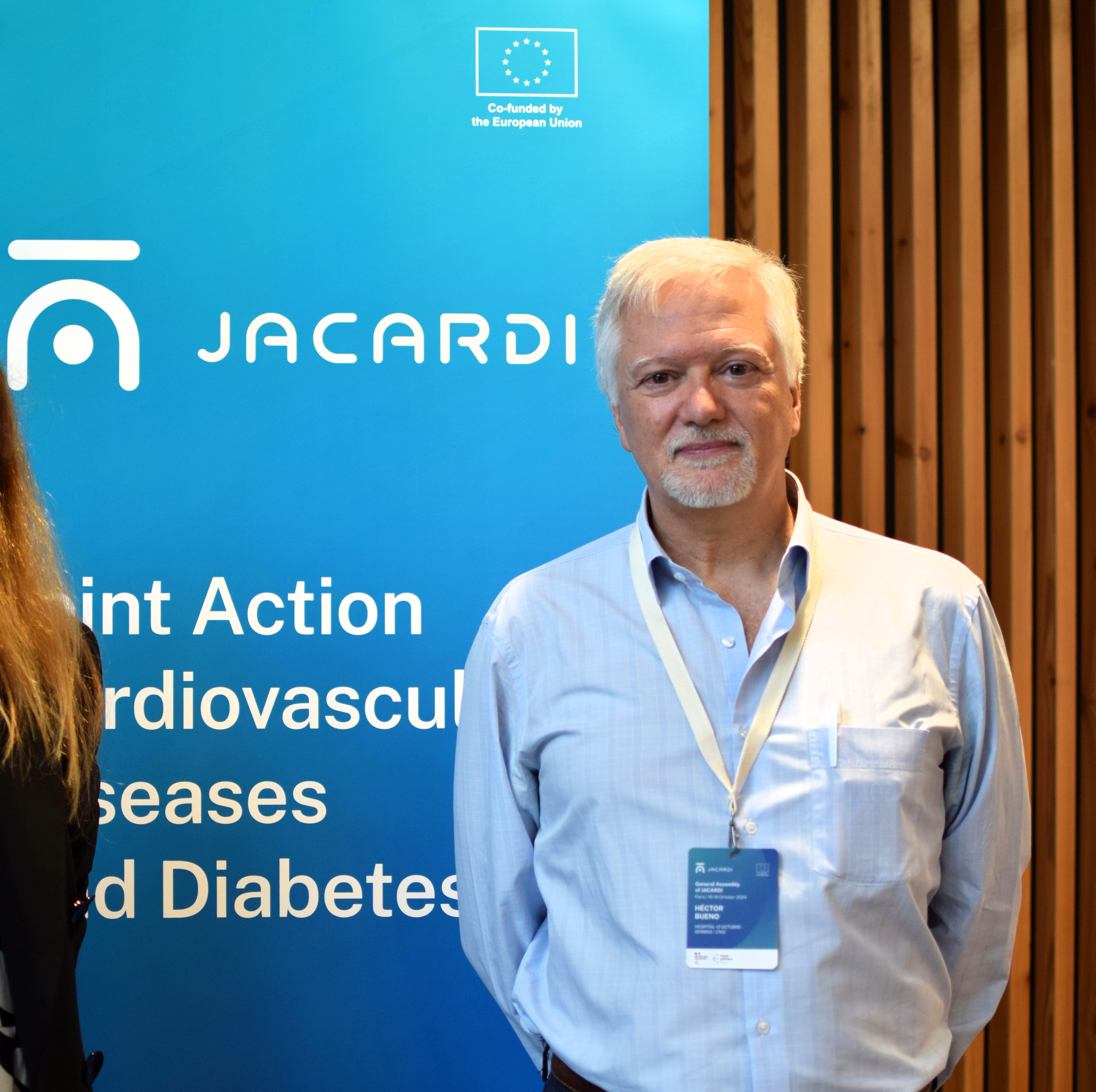
Dr. Bueno: "Data is not just numbers; it is the basis for designing policies that reduce inequalities and improve the health of the entire population”
Dr. Héctor Bueno, one of the authors of the document and leader of the JACARDI working group on data availability and quality, emphasizes the importance of coordinating and strengthening health information systems in order to achieve continuous, systematic, and standardized monitoring that will ensure more effective and equitable policies. “To advance the fight against NCDs, we need information systems that are robust, inclusive, and sustainable. Data are not just numbers; they are the basis for designing policies that reduce inequalities and improve the health of the entire population”.
The coordinator of the Cardiovascular Research Area at the Instituto de Investigación i+12 and head of the Multidisciplinary Translational Cardiovascular Research Group at i+12 at the Hospital Universitario 12 de Octubrein Madrid, and leader of a research group at the Spanish National Center for Cardiovascular Research (CNIC), insists that “it is time to invest in robust and collaborative surveillance systems so that healthcare decisions are based on real evidence and have a lasting impact on people's health.”
A call to action: five priorities for 2025 and beyond
The publication highlights five critical areas where action is needed to make monitoring systems stronger, fairer, and more effective. It calls for collecting data that is truly inclusive and disaggregated, so that inequalities become visible and can be addressed. It stresses the importance of solid governance, clear legal frameworks, and long-term investment to ensure that progress is sustained.
Monitoring, the authors argue, should also be embedded in real-time policymaking, so that information directly shapes decisions and drives accountability. Civil society, communities, people with lived experience, and marginalized groups should have a meaningful voice in this process, making sure that data reflects people’s lived realities. And finally, the paper points to the need for stronger collaboration across sectors, greater sharing of knowledge, and more capacity building to secure lasting impact.
80% of NCDs can be prevented through effective public health policies and early detection strategies
“Tackling NCDs is one of five priorities of WHO/Europe’s Second European Programme of Work, co-created with 53 Member States and shaped through broad public consultations, including with health professionals, people living with NCDs and civil society. Effective action on NCDs hinges on good data. Europe can lead by example and showcase collaborative and inclusive approaches together with key stakeholders, including EU Joint Actions”, said Dr. Gundo Weiler, Director of the Division of Prevention and Health Promotion at WHO Regional Office for Europe.
The challenge: gaps between commitments and reality
An estimated 80% of NCDs are considered preventable through effective public health policies and early detection strategies. These figures underscore the urgent need for a paradigm shift from a model centred on diagnostics and treatment to one rooted in prevention, health promotion, and evidence-based screening.
Despite great efforts in international commitments, progress at the national level has been inconsistent. Monitoring systems remain fragmented, overly reliant on short-term projects, or challenged by limited governance and insufficient investment. This has created a critical gap between ambitious global targets and their translation into actionable national policies.
The policy paper identifies persistent data gaps, structural weaknesses, and opportunities for innovation. It emphasizes that monitoring is not just about collecting data, it is about ensuring that information is used in real time to drive policy reform, accountability, and equity.
Lessons from Europe
The authors underline that too often, NCD monitoring efforts have been ad hoc, reliant on external funding or driven by individual champions. This has led to uneven coverage, lack of comparability between countries, and persistent blind spots when it comes to the health of groups living in vulnerable situations, such as migrants, minorities, and people with disabilities.
Without data that is disaggregated and reflects disparities, inequalities remain invisible and policies risk reinforcing exclusion. The authors argue that equity must be at the center of all future monitoring efforts.
Dra. Armocida: “We should begin to view data not only as numbers, but as reflections of lives and human rights"
“It is a moral and ethical imperative to advocate for and generate more inclusive data. Data should be systematically disaggregated by age, sex, gender, geography, socioeconomic status, disability, ethnic and migration background to reveal territorial disparities and enable place-based interventions”, unfolds Dr. Benedetta Armocida, from the Department of Cardiovascular, Endocrine-metabolic Diseases and Aging at Istituto Superiore di Sanità-ISS, Rome (Italy) and Coordinator of JACARDI.
“We should begin to view data not merely as numbers, but as reflections of human lives and rights: each data point tells a story, and data becomes truly powerful when it shifts narratives, amplifies the voices of those too often overlooked, and holds systems accountable. Data must be observed critically and translated into policies that strengthen health systems. Without inclusive monitoring, structural inequities remain concealed, and the most vulnerable remain invisible—one data point, one life, one missed opportunity at a time”, adds Dr Armocida.
At the same time, the authors highlight successful innovations and good practices emerging from European Joint Actions, such as JACARDI and JA PreventNCD, demonstrating that progress is possible when commitments are matched by clear governance, adequate investment, and cross-sector collaboration.
“Across Europe we already see solutions that work. Joint Actions like JA PreventNCD and JACARDI help countries align methods, share tools and learn faster from each other. That is how we improve comparability between countries and make monitoring more useful for prevention and health promotion, including by showing more clearly where inequalities persist,” says Professor Knut-Inge Klepp, from the Norwegian Institute of Public Health, Oslo and Scientific Coordinator of JA PreventNCD.
“But we have to treat monitoring as core infrastructure, not an extra task. It needs stable funding, clear governance and the ability to produce data that is timely and inclusive. If monitoring depends on short-term projects or individual champions, it will remain uneven. If it is institutionalized, it can guide priorities, strengthen accountability and help sustain progress over time,” adds Klepp.
Europe has both a responsibility and an opportunity to lead the way in building stronger, more inclusive health information systems that can serve as a global benchmark. Doing so will be critical not only to reducing premature mortality from NCDs by one-third by 2030, but also to ensuring health equity and resilience in the face of future challenges. “Because what gets measured gets prioritised. What gets disaggregated gets addressed. And what gets institutionalised can be sustained”, conclude the authors.
Benedetta Armocida, Hanna Tolonen, Ivo Rakovac, Beatrice Formenti, Jill Farrington, Allison Ekberg, Hector Bueno, Giovanni Capelli, Silvia Francisci, Morten S. Frydensberg, Ane Fullaondo, Linda Granlund, Yhasmine Hamu Azcarate, Torben F. Hansen, Emil Høstrup, Tomi Mäki-Opas, Luigi Palmieri, Markku Peltonen, Valentina Possenti, Marco Silano, Gundo Weiler, Kremlin Wickramasinghe, Edwin Wouters, Knut-Inge Klepp, Graziano Onder, Gauden Galea, Strengthening non-communicable diseases monitoring systems in Europe through a multistakeholder collaborative approach: a key priority for advancing data-driven policymaking, The Lancet Regional Health - Europe, Volume 61, 2026, 101553, ISSN 2666-7762, https://doi.org/10.1016/j.lanepe.2025.101553