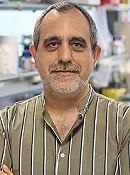
José Antonio Enríquez earned his degree in Biochemistry and Molecular Biology from the Autonomous University of Madrid and his PhD from the University of Zaragoza (UniZar) in 1992. During his thesis, he studied various aspects of mitochondrial DNA (mtDNA) biogenesis. Between 1993 and 1997, he worked with G. Attardi at the California Institute of Technology (CALTECH), where he investigated the pathogenic action of mutated mitochondrial tRNAs. His work during this period helped define the underlying molecular mechanism of this phenomenon and establish a general methodology for studying mitochondrial tRNAs. This methodology has been applied in studies of mitochondrial biogenesis as well as in the analysis of mtDNA-related diseases.
In 1997, José Antonio returned to UniZar as an Assistant Professor to start his independent research group (GENOXPHOS), becoming an Associate Professor in 1999 and a Full Professor at UniZar in 2007. Dr. Enríquez joined CNIC in 2009, where he focuses on elucidating the molecular mechanisms of mitochondrial dysfunction in cardiovascular diseases and ischemic processes.
Recent Achievements and Funding (2024-2025)
The GENOXPHOS group has consolidated its international leadership in mitochondrial research with significant milestones:
- ERC-2024-ADG Consolidator Grant: The group has been awarded the prestigious Horizon Europe ERC Advanced Grant 2024 for the project “Cell-Cell Communication by Mitochondrial Intercellular Traffic” (MINTRAF) , providing substantial funding to investigate mitochondrial intercellular traffic.
- High-Impact Publications: Recent research in leading journals such as Cell Genomics (2025) has revealed the molecular evolutionary strategies of the OxPhos system, developing predictive tools such as ConScore for pathogenic variants .
- International Collaborations: The group leads the CIBERFES network (Aging and Frailty) and maintains active collaborations with institutions such as CALTECH and European research centers .
Current Research Lines
For over 25 years, the GENOXPHOS group’s research activity has focused on studying the mammalian mitochondrial electron transport chain (MtETC) and the H+-ATP synthase, which constitute the oxidative phosphorylation system (OxPhos). Current research is structured around four main axes:
- Functional consequences of mtDNA genetic variability.
The most notable work has demonstrated in humans and mice that population variability in mtDNA conditions organism metabolism, drug response, disease predisposition, healthy aging, and helps explain threshold pathology and functional variability of mtDNA alterations. Together, these contributions highlight the role of mitochondrial ROS in the adaptation of the OxPhos system to the metabolic requirements of the cell. - Development of new structural organization models of mitochondrial electron transport.
Based on observations and methodology developed by Dr. Schägger, the GENOXPHOS group’s work is transforming understanding of mitochondrial respiratory chain structure and function, giving rise to the proposal of the “Plasticity Model” to explain the dynamic organization of the mitochondrial electron transport chain. On one hand, this model, and the work from which it derives, explain the functional value of respiratory complex associations in superstructures, describe the first truly necessary protein factor for physical interaction between complexes. It demonstrates the dynamic organization of the respiratory chain to optimize the use of different carbon sources and provides experimental proof of the proposed plasticity model. This research has enabled connecting mitochondrial dynamics with bioenergetic function. Furthermore, in the context of the plasticity model, it has been possible to explain the determining role of structural isoforms of complex IV of the mitochondrial electron transport chain in its homodimerization capacity and its ability to interact with other complexes. - The role of OxPhos in metabolic adaptation.
A key advance in understanding the processes by which cells optimize and molecularly regulate their metabolic capacity, inducing structural changes in the electron transport chain. Unexpectedly, these adaptations are especially relevant in cardiovascular pathology and the immune system. - Cardiometabolic biology and pathology.
The group has defined the mitochondrial stress protease OMA1 as a promising target for preventing heart failure; the relevance of the tyrosine kinase Fgr in regulating inflammation and obesity; and the discovery of the role of resident heart macrophages in the proper elimination of mitochondria damaged by cardiomyocytes.
| Surname and name | Position | CV | Extension | |
|---|---|---|---|---|
| Cabrera Alarcón José Luis | Postdoc researcher | --- | Ext. 70307 | Contact |
| Morales Vidal Carmen | Postdoc researcher | --- | Ext. 70259 | Contact |
| Pérez-Hernández Durán Marta | Postdoc researcher | --- | Ext. 70166 | Contact |
| Veliova Michaela | Postdoc researcher | --- | Ext. 70478 | Contact |
| Acín Pérez Rebeca | Senior technician | --- | Ext. 70634 | Contact |
| Jiménez Gómez María Concepción | Senior technician | --- | Ext. 3321 | Contact |
| Fernández-Montes Díaz Paula | Predoc researcher | --- | Ext. 70546 | Contact |
| Garoz Martínez Paula | Predoc researcher | --- | Ext. 71523 | Contact |
| Hernández Parada Yender Valois | Predoc researcher | --- | Ext. 71207 | Contact |
| Jaroszewicz Sara Natalia | Predoc researcher | --- | Ext. 70560 | Contact |
| Domínguez Gómez Lorena | Technician | --- | Ext. 70685 | Contact |
| Martínez de Mena Raquel Rosa | Technician | --- | Ext. 70723 | Contact |
| Martínez Jiménez Eva Raquel | Technician | --- | Ext. 70604 | Contact |
| Muñoz Hernández María del Mar | Technician | --- | Ext. 70316 | Contact |
| Florensa Jordan Joan | Visiting scientist | --- | Ext. 71598 | Contact |
| Justo Méndez Raquel | Visiting scientist | --- | Ext. 70430 | Contact |
| Lechuga Vieco Ana Victoria | Visiting scientist | --- | Ext. 70713 | Contact |
| Ruiz-Cabello Osuna Jesús María | Visiting scientist | --- | Ext. 71299 | Contact |
| Simón Guerrero Carolina Amalia | Visiting scientist | --- | Ext. 71407 | Contact |
| Domínguez Calderón Lucía | Visiting student | --- | Ext. 71596 | Contact |
| Martínez Jiménez Laura | Visiting student | --- | Ext. 71590 | Contact |